In the strategy using SMS messages (so-called Smishing), small amounts are often used. For example, we might receive a message informing us that our parcel will be returned to the sender due to an underpayment of 1 EUR (or another minimal amount, e.g., 0.50 EUR). The thinking mechanism in this situation is simple, fast, and effective:
- Low amount: „This is not a high amount! Actually, none at all. I can pay it immediately.”
- High cost of return/problem: „On the other hand, how much trouble, time, and stress will we have when the parcel returns to the sender? Getting it back will take weeks.”
- Time pressure: „This must be sorted out immediately, because the courier will leave soon/the system will return it.”
This combination of minimal cost (1 EUR is not much) and maximum potential problem (losing the parcel) makes us inclined to click the link and provide our credit card or online banking details to settle the „underpayment” without thinking. In this way, scammers gain access to our financial data, which they then use for much larger thefts. Scams based on small amounts and time pressure are particularly effective because they bypass our rational ability to verify the sender’s authenticity.
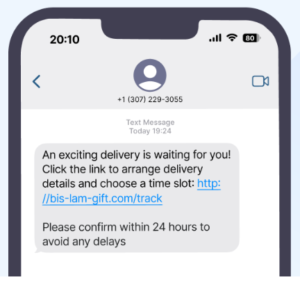
Source: https://www.textmagic.com/blog/spam-text-message-examples-and-how-to-identify-them/