Fake photos – what should we look out for?
Pitfalls in numbers – polls that never took place
Alongside fake faces and videos, images are circulating online that are designed to look like ‘news clippings’. Their aim is to give the impression that a particular party enjoys massive support or that something sensational has happened. The fraudsters are banking on the fact that, upon seeing a familiar-looking table or graph, we won’t bother to check the facts.
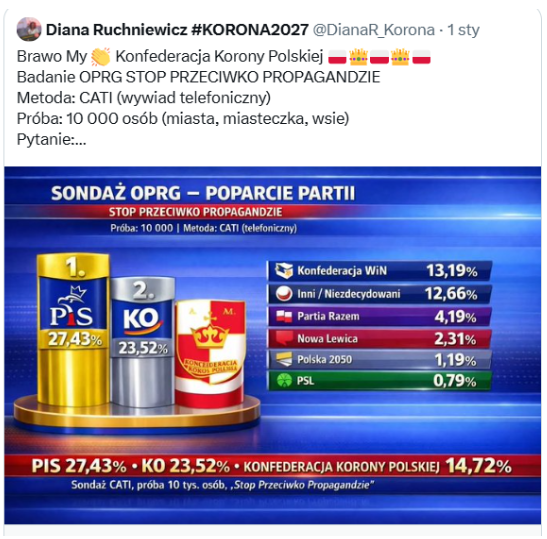
Let’s take a look at this image together. Although it looks professional at first glance, it contains a host of errors that render it unreliable:
- A phantom institute (OPRG): We should always check who carried out the survey. In Poland, we’re familiar with organisations such as CBOS, IBRiS and Kantar. The name ‘OPRG’ does not appear in any register of reputable research institutions. It’s a name invented for the purpose of manipulation.
- The dubious ‘sample of 10,000 people’: It sounds impressive, doesn’t it? However, in reality, professional election polls are usually conducted on a sample of around 1,000 people. Surveying 10,000 people by telephone would be extremely expensive and highly unusual. Scammers quote a large number to make the poll seem ‘more credible’, which, paradoxically, gives away their lie.
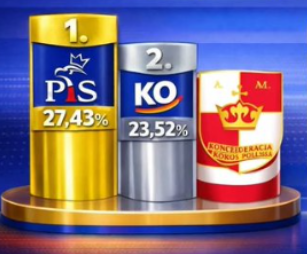
- Errors on the podium: Take a look at the columns. 1st place (PiS) and 2nd (KO) have their percentages written directly on the gold and silver bars. Third place is ‘empty’ – the graphic designer forgot to add the result there, even though the list next to it shows over 14 per cent. This is a classic mistake made during a rushed, sloppy edit.
- Nonsensical, distorted text: The text on the third bar is a cheerful creation of artificial intelligence. Despite the poor quality of the photo, we can see that instead of the party’s real name, there is text that sounds like a joke: ‘Konfederacja Kokos Pollssa’.
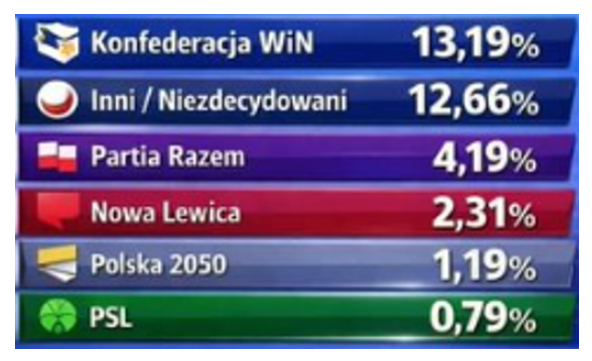 The logos of other parties (such as Polska 2050 or the PSL) differ from those we are familiar with from official posters or websites. AI often struggles to accurately reproduce logos and text within images.